
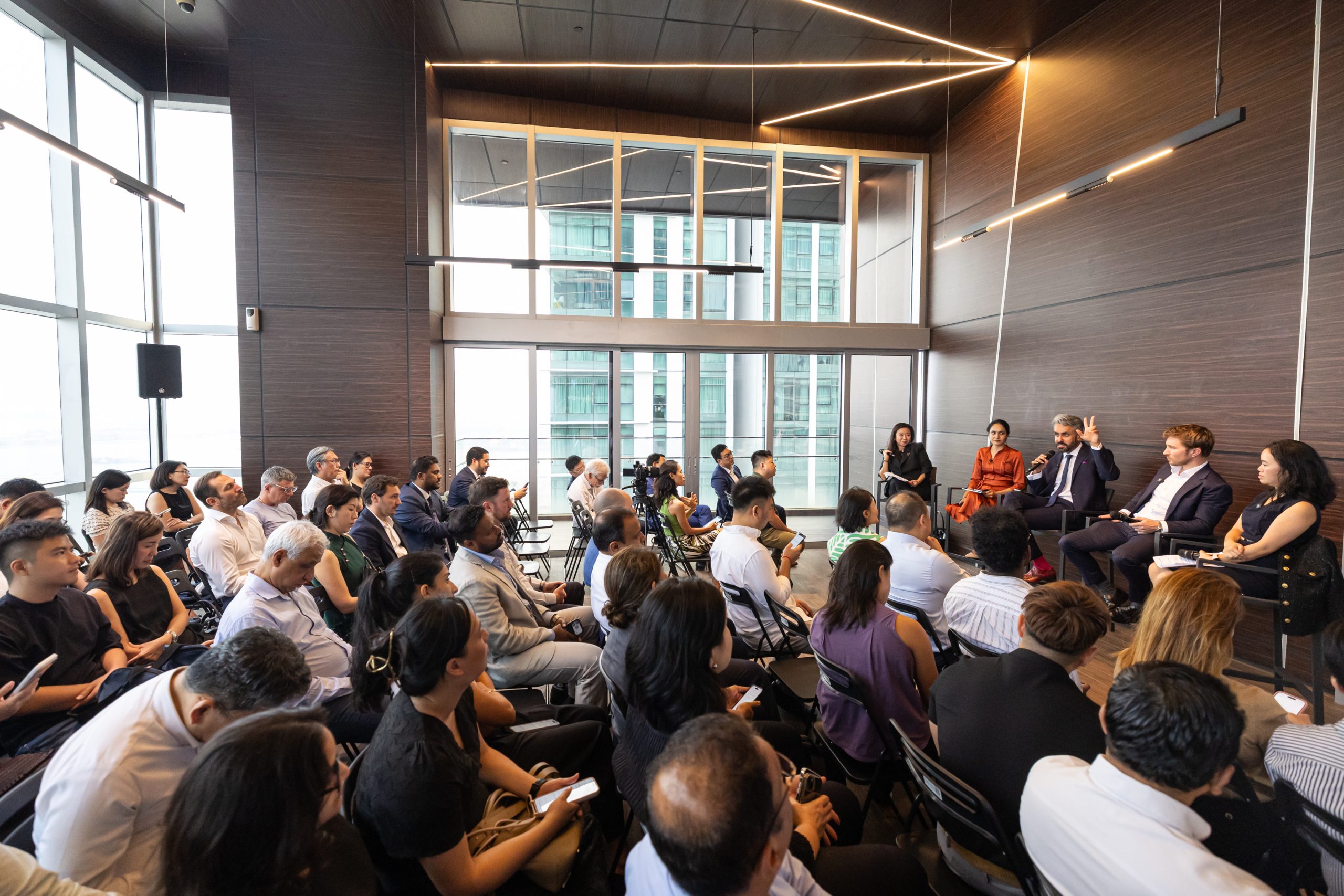
We were pleased to see so many familiar faces at our seminar in conjunction with our annual party in Aug 2026.
Here, a summary of mitigating risk and managing recovery, from our expert panel that included speakers from Aon and Kroll. Enjoy the photos and we look forward to welcoming you for our next event.
Key Takeaways
Contract Alignment
Whilst not practical to have one-sided contractual wording, traders should ensure their contractual obligations are back-to-back in chain contracting.
Contractual wording should be considered carefully to align with insurance policy wording, such as Insured Debt, as well as security documentation such as guarantees.
Map Supply Chain
Supply chains are a big vulnerability and traders should map out and plan for diversified supply chains.
Creating & Stress-Testing Operational Protocols
Teams that are prepared will be better equipped to navigate geopolitical upheavals.
This includes clear protocols for contingency planning and diversification of supply chains, documented rationale for decisions such as allocation of limited cargo and enforcement planning in the event of non-payment.
Clear escalation protocols to management and legal teams would help to save time and mitigate prejudicial acts.
Dynamic Sanctions Monitoring
Sanctions monitoring is no longer a compliance task at the start of the transaction.
Sanctions monitoring needs to be done during the lifecycle of the trade, and contingency planning needs to be considered in the event payment is delayed or disrupted by banks because of sanctions concerns.
Information
The start of any recovery exercise requires information gathering. The best sources of information may not be from the debtor itself, but from third parties such as banks, auditors or company secretaries.
A freezing order typically comes with a disclosure of asset obligation but creditors should not be over-reliant on obtaining information from the debtor.
Disclosure orders can be obtained against banks in the appropriate circumstances.
Control
Control is the high watermark for asset recovery. Appointing a liquidator or receiver over the assets of the company places control out of the debtor.
Leverage
Claims against related parties, for example conspiracy or sham transactions, often expose sensitive third parties thereby creating indirect pressure on the debtor.
Freezing orders are high costs items that should be deployed carefully considering both the debtor position as well as whether there are much larger creditors that would blunt the leverage of a freezing order.
Freezing orders or Chabra orders (against nominees), if deployed effectively, can have a chilling effect, thereby maximising leverage over the debtor.
Questions from the Floor
What is the biggest risk that people aren't focused on?
The biggest risk is often not the disruption itself, but a lack of preparedness for it.
Events such as war and natural disasters tend to expose existing weaknesses, including misaligned contracts, unclear decision-making authority, inadequate escalation procedures and poor evidence-gathering practices.
The organisations that navigate disruption most effectively are those that have already put in place the contractual protections, operational processes and governance frameworks needed to respond quickly and decisively.
How much evidence should a business be gathering before it declares force majeure?
A force majeure notice should ideally be the culmination of an evidence-gathering exercise, rather than the starting point.
Before declaring force majeure, a business should document the disruption itself, the effect on its ability to perform, any efforts to secure replacement supply, allocation decisions, additional costs incurred and the mitigation steps taken.
Where it is not possible to gather all of that information before issuing a notice, the business should continue to maintain comprehensive records as the situation unfolds.
At what point should legal be brought into the discussion?
Earlier than when a disruption occurs or a dispute starts to emerge.
Ideally, legal should be involved as soon as a credible disruption risk emerges. The objective is not necessarily to prepare for a fight, but to ensure the business is well positioned to respond if the disruption materialises.
Waiting until a dispute emerges can mean notice periods have been missed, evidence lost, rights waived through premature concessions and insurance cover prejudiced.
What would typically be excluded from Political Risk Insurance?
For Political Risk Insurance covering contract frustration and breach of contract risks, common market exclusions include:
- Insolvency, bankruptcy or financial default of the insured
- Fraudulent, dishonest or criminal acts or omissions of the insured
- Specified radioactive, chemical, biological and related risks
- Material default by the insured under the insured contract
- Material disputes until resolved in the insured's favour by arbitration
Insurers may require additional exclusions to become comfortable with more complex transactions.
Freezing orders disregard who went first — but isn't there a first-mover advantage once summary judgment has been issued?
Yes. The two stages work differently, and the distinction is worth drawing.
A freezing order preserves assets. It gives you no proprietary interest and no priority: you are simply making sure something is left when judgment comes.
Enforcement is different. Once you have judgment, the remedies used to collect can create priority, including seizure and sale, attachment of debts owed to the debtor and charging orders.
The important qualification is that insolvency resets the race. The first-mover advantage generally survives only if enforcement is completed before an insolvency process intervenes.
Is it possible to recover from auditors of rogue companies after Deloitte v Hin Leong?
Yes, but the claim must be appropriately scoped.
In July 2026 the Court of Appeal struck out the bulk of the Hin Leong liquidators' claim against Deloitte, including roughly US$2.6 billion of trading losses said to have been avoided if competent audits had forced an earlier liquidation.
Two claims survived and are proceeding to trial. The route that remains open is to identify a specific source of loss that a proper audit would have caught and show that it was likely to generate losses.
Considering legal costs, what is the minimum loss worth pursuing?
There is no single figure. The better question is the ratio between what can realistically be recovered and what the first phase will cost.
For a single jurisdiction, identified assets and a solvent defendant, ordinary debt recovery can make sense well below US$1 million.
Cross-border cases involving nominee structures and unidentified assets can require a substantial six-figure exercise before the substantive claim is even filed.
The variable that moves the threshold most is often not the size of the claim, but whether the assets have been located and whether they are reachable.
With a multi-million dollar debt against one debtor, how do we decide whether an asset freeze is worth it?
- Have the assets been identified, and where are they?
- Can the order be enforced where the assets sit?
- Can you evidence a real risk of dissipation?
- Who else is chasing the debtor?
- What is the exposure under the cross-undertaking in damages?
- Will the freeze destroy the value being pursued?
- Is there a cheaper route?
Creditors are reluctant to throw good money after bad. What funding options exist in insolvency?
A liquidator can assign a share of the proceeds of an estate claim to whoever funds it.
A creditor that funds the action can also ask the court for priority over other creditors out of what is recovered.
Commercial litigation funding and after-the-event insurance may also be available.
How easy is it to pierce the corporate veil once fraud has been established?
Harder than most people expect, and proving fraud does not by itself achieve it.
The more useful point is that establishing fraud can unlock better remedies than veil-piercing. It can support proprietary claims, tracing, freezing orders against nominees and conspiracy claims against those who assisted.