Mitigating Risk & Managing Recovery in a Volatile World (Seminar)

Thank you for sharing the evening with us. We hope these resources serve as a valuable reference after the session.

Connect with the Speakers

Mitigating Risk: Challenges & Risk Mitigants

Challenges

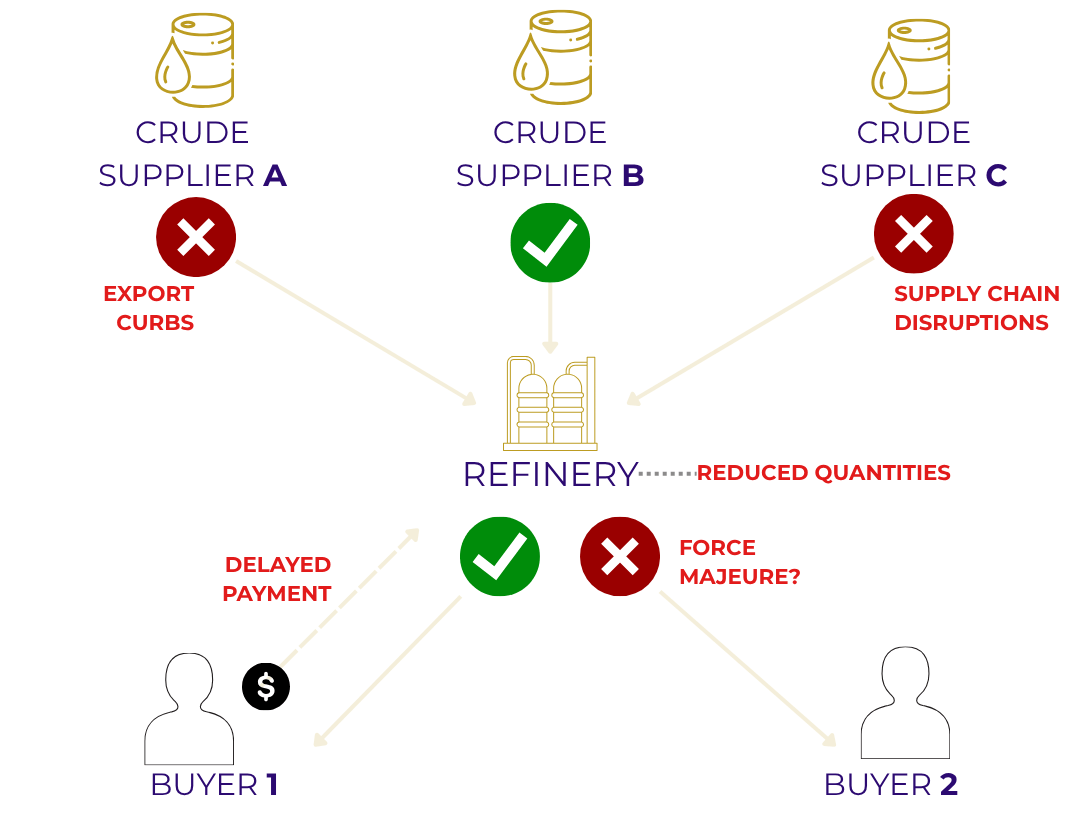
1. Force majeure pitfalls
  1. Price spikes
  2. Supplier’s FM
  3. Selective performance
  4. Late payments and instalment requests
2. Government export curbs
Unlike production outages, government restrictions may block export even though the product exists.
3. Sanctions
Sanctions exposure can change mid-contract, making a transaction unlawful or causing banks, shipowners, ports and insurers to pause or withdraw.
4. Changing supply chains
Alternative suppliers and routes may ease immediate shortages but introduce delays, higher costs, different specifications and new counterparties.
5. Currency shortage
A solvent buyer may be unable to convert local currency or transfer payment offshore because of hard-currency shortages or government restrictions.

Risk Mitigants

1. Insurance solutions
  1. Non-payment / trade credit insurance
  2. Trade disruption insurance
  3. Political risk insurance
2. Contractual protections
  1. Force majeure clause
  2. Back-to-back supply chain alignment
  3. Reduction and allocation of scarce supply
  4. Change of law and government action
  5. Sanctions
3. Operational readiness
  1. Contract alignment
  2. Supply chain mapping & diversification
  3. Stress testing and contingency planning
  4. Escalation protocols
4. Dynamic sanctions monitoring
Monitor sanctions exposure throughout the transaction so new designations, licence changes and third-party concerns can be escalated promptly.
Mitigating Risk: Scenario
Mitigating Risk scenario
Asset Recovery: Challenges & Legal Toolkit
Challenges
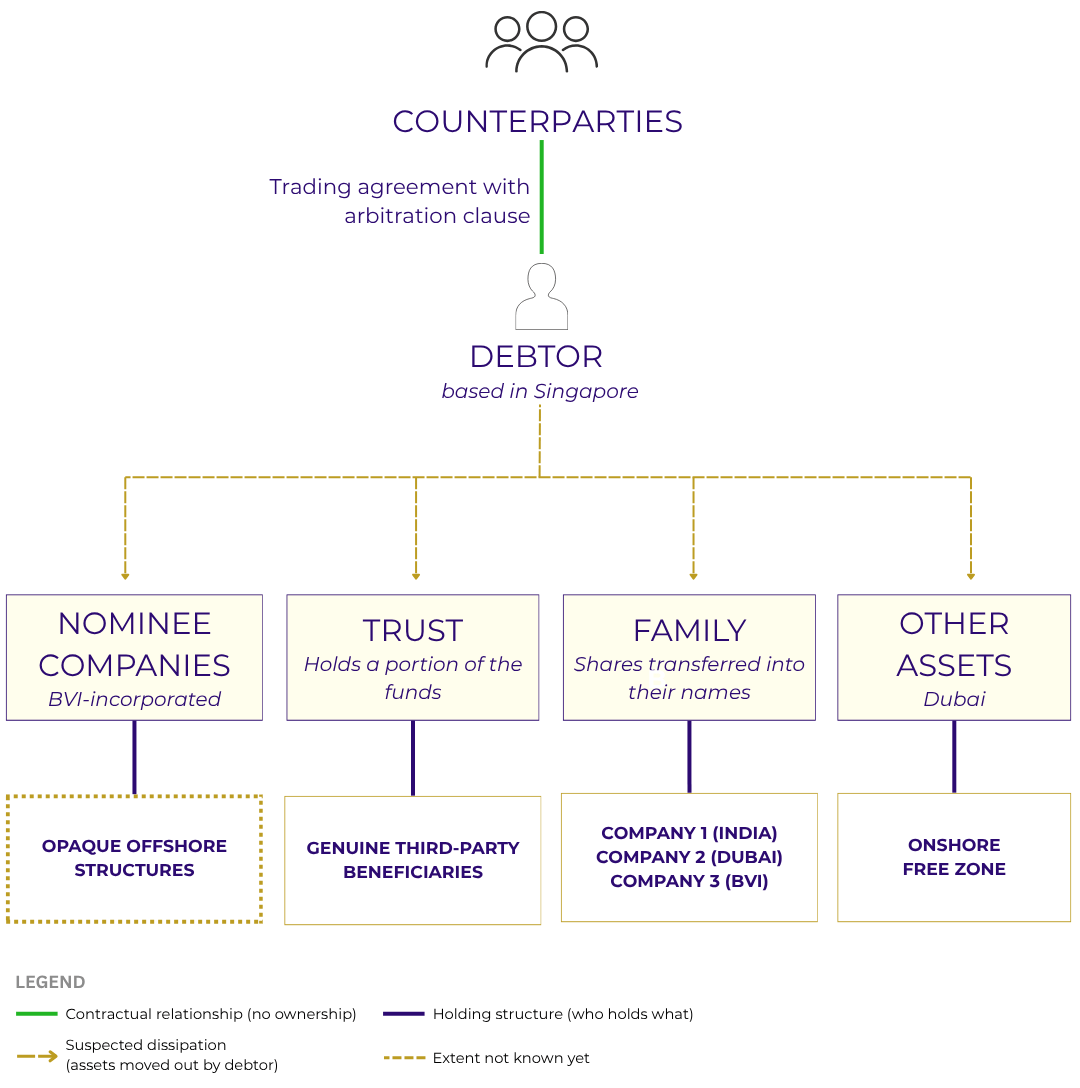
1. Sham Related-Party Trades
Funds are moved to related companies under the pretext of genuine trading activity — disguised repo-style trades, round-trip payments — building a paper trail that looks commercial but isn’t.
2. Friendly Companies
Money is funnelled through companies that look independent on paper but are quietly loyal to, or controlled by, the debtor — used to receive and re-route funds without an obvious ownership link.
3. Nominee Control
Companies are held and directed through nominee directors and shareholders, so the public and corporate record never shows the debtor’s real ownership or control.
4. Layered Offshore Structures
Assets pass through multiple opaque jurisdictions, each layer designed to break the evidentiary link to the layer before it — multiplying the number of courts and registries a recovery team must engage.
5. Trusts
Assets are settled into a trust, often via a nominee settlor, placing them behind a separate legal relationship — with real control frequently retained informally through a protector role.
6. Corporate Veil Shielding Personal Liability
The debtor hides behind a company’s separate legal personality — and courts are genuinely reluctant to disregard it, making this a much narrower route than clients often expect.
7. Creditor Reluctance
Facing all of the above, creditors are understandably wary of spending good money after bad — recovery costs and uncertain enforceability make the decision to pursue a case a real commercial judgment call.
Asset Recovery Toolkit
Find
1. Disclosure orders

Compels disclosure of assets and information

Use When
You need to identify assets or the wrongdoer
Key Limit
No fishing, can tip off the debtor
2. Search orders (Anton Piller)

Preserves evidence at risk of loss

Use When
Documents or devices may be destroyed
Key Limit
Exceptional; very high threshold
Hold
3. Freezing orders (Mareva / WFO)

Restrains dealing with assets

Use When
Personal claim — debt or damages
Key Limit
No priority; ordinary payments continue
4. Proprietary injunctions

Fastens on one identified asset

Use When
You claim ownership of the asset itself
Key Limit
Closes on sale to a good-faith buyer
5. Chabra relief

Extends the freeze to a holder

Use When
A nominee or affiliate holds the assets
Key Limit
Affiliation alone is not enough
Take Control
6. Receivership / liquidation

An officer of the court takes control

Use When
The debtor will not cooperate
Key Limit
Needs its own appointment
The pivot: from asking the debtor to compelling the estate
Recover
7. Clawback / avoidance claims

Unwinds undervalue transfers and preferences

Use When
Assets were moved before insolvency
Key Limit
Only once an office-holder is appointed
8. Conspiracy claims
9. Piercing the corporate veil
Last Resort

Disregards the company itself

Use When
A company was interposed to evade a duty
Key Limit
Very narrow; alternatives are usually better
Asset Recovery: Scenario
Asset Recovery scenario
Questions

Or get in touch with us at business@blackstonegold.com .

Insights

2026 Risk Mitigation Report: Risk, Resilience & Recovery
A key report for stakeholders navigating risk and how to structure design choices around verification,
GTR Asia 2026 Singapore
Our MD, Baldev Bhinder moderated an interactive panel at GTR Asia, using a case study
Asset Recovery Series: Finding the Money – Investigation and Disclosure Before Judgment
Recovery is a race against information. By the time a cause of action accrues, the
After the 2020 collapse of commodity traders such as Hin Leong and Zenrock left banks